Martingale Strategy: Myth or Winning System?

Want expert predictions delivered daily?
Get free tips on Telegram or upgrade to Premium.
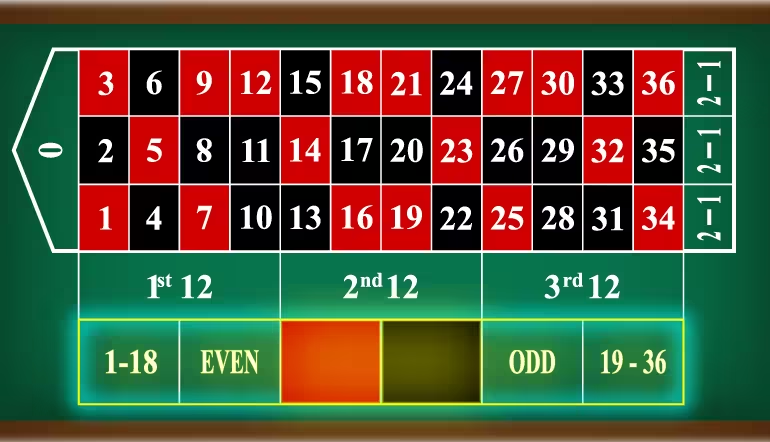
The Martingale strategy is often presented as a foolproof system for winning at casino games, especially those with even-money bets like roulette. However, in reality, it is a high-risk approach that can quickly lead to significant losses rather than guaranteed wins, making it more of a myth than a reliable winning system.
This article will break down exactly how the Martingale strategy works, why it appeals to many players, and its major flaws. By understanding its true nature in casino games, you will be better equipped to make responsible betting decisions and avoid common pitfalls.
What Exactly is the Martingale Strategy?
The Martingale strategy is a betting system that originated in 18th-century France, primarily used in games where the player has roughly a 50% chance of winning, such as betting on red or black in roulette, or the player/banker in baccarat. The core idea is simple: after every loss, you double your previous bet.
The theory behind this is that when you eventually win, you will recover all your previous losses and gain a profit equal to your original stake. This continuous doubling is supposed to guarantee a win, as long as you have enough money and there are no betting limits.
How the Martingale Strategy Works in Practice
To understand the Martingale strategy better, let's walk through a simple example using a game like roulette, where you bet on an even-money outcome such as 'red'. The goal is to recover any losses and make a profit equal to your initial bet.
Here is a step-by-step example showing how the bets would progress if you started with a $10 wager and kept losing:
| Bet Number | Outcome | Bet Amount | Cumulative Loss | Potential Win (if next bet wins) |
|---|---|---|---|---|
| 1 | Loss | $10 | $10 | $10 |
| 2 | Loss | $20 | $30 | $20 |
| 3 | Loss | $40 | $70 | $40 |
| 4 | Loss | $80 | $150 | $80 |
| 5 | Loss | $160 | $310 | $160 |
| 6 | Loss | $320 | $630 | $320 |
| 7 | Win | $640 | -$630 + $640 = $10 profit | $640 |
As you can see from the table, after six consecutive losses, the seventh bet becomes very large. If that seventh bet wins, you recover all $630 previously lost and make a $10 profit, which is your original stake.
Why People Believe Martingale is a Winning System
The Martingale strategy gains its appeal from the simple mathematical logic that a losing streak cannot last forever. Eventually, a win must occur, and when it does, it theoretically wipes out all previous losses and secures a small profit.
In the short term, players might experience success, especially if they encounter only short losing streaks. This creates an illusion of a reliable system, leading many to believe that they have found a way to beat the casino. However, this belief overlooks fundamental aspects of casino gaming.
The Major Flaws of the Martingale Strategy
Despite its attractive simplicity, the Martingale strategy has critical flaws that make it unsustainable and dangerous in the long run. These flaws are why it is considered a myth rather than a true winning system.
Table Limits
One of the most immediate problems with the Martingale strategy is the existence of table limits in casinos. Casinos set minimum and maximum bet amounts for all their games to protect themselves from strategies like Martingale.
When you double your bet after each loss, your wagers can quickly reach the table's maximum limit. Once you hit this limit, you can no longer double your bet, meaning you cannot recover your losses with the next win, and the strategy completely breaks down.
Bankroll Depletion
Another significant flaw is that the Martingale strategy requires an infinitely large bankroll, which no player possesses. While individual losing streaks might seem unlikely to go on for too long, they are an inevitable part of gambling.
Even a relatively short string of losses can require an enormous amount of money for the next bet. For instance, in our earlier example, just six losses in a row meant risking $640 to win back an initial $10. Most players simply do not have the funds to sustain such rapid bet increases.
House Edge Remains
Crucially, the Martingale strategy does nothing to change the inherent house edge that casinos have in their games. Whether you bet $10 or $1000, the probability of winning any single bet remains the same, slightly in favor of the casino.
For example, in roulette, the presence of the green zero (or double zero) means that betting on red or black is not truly a 50/50 proposition. The house edge ensures that over many bets, the casino will always come out ahead, regardless of the betting pattern you use. Understanding what are betting odds is key here.
Risk vs. Reward Imbalance
The Martingale strategy involves risking increasingly large sums of money to win back only your original small stake. The potential reward does not justify the escalating risk.
Consider the example again: after six losses, you're risking $640 to win a mere $10 profit. This imbalance means that a single, unlucky long losing streak can wipe out all previous small wins and a significant portion of your bankroll, making it a very inefficient way to manage your funds.
Practical Example: Martingale in Roulette
Let's imagine you're playing roulette and decide to bet on 'black' with an initial stake of $5. You have a bankroll of $500, and the table limit is $500.
- Bet 1: You bet $5 on black. It lands on red. You lose $5.
- Bet 2: You double your bet to $10 on black. It lands on red. You lose $10 (total loss: $15).
- Bet 3: You double again to $20 on black. It lands on red. You lose $20 (total loss: $35).
- Bet 4: You double to $40 on black. It lands on red. You lose $40 (total loss: $75).
- Bet 5: You double to $80 on black. It lands on red. You lose $80 (total loss: $155).
- Bet 6: You double to $160 on black. It lands on red. You lose $160 (total loss: $315).
- Bet 7: You double to $320 on black. It lands on red. You lose $320 (total loss: $635).
At this point, you've lost $635, which is more than your initial $500 bankroll, and you haven't even hit the table limit yet. If you had continued, your next bet would be $640, which exceeds the $500 table limit, making it impossible to continue the strategy. This demonstrates how quickly the bets escalate and how easily your funds can be depleted.
Responsible Betting and the Martingale Strategy
Given the significant risks involved, it is important to approach the Martingale strategy with extreme caution, if at all. No betting system, including Martingale, can overcome the inherent house edge or guarantee profits in casino games.
Responsible betting means understanding that gambling is a form of entertainment with no guaranteed returns. Always set strict limits on how much money you are willing to lose and stick to them. It is also wise to manage your funds properly by learning about responsible bankroll management to bet smarter, not bigger.
Alternatives to the Martingale Strategy
Instead of relying on systems like Martingale, which are mathematically flawed, players should focus on understanding the games they play and managing their money wisely. There are no magic bullets in gambling, but informed decisions can enhance your experience.
Here are some more sensible approaches to consider when playing casino games:
- Understand Game Mechanics: Learn the rules, odds, and probabilities of the games you choose. Knowing the Casino Games with the Highest Return to Player (RTP) can give you a better chance over time.
- Bankroll Management: Set a budget for your gambling activities and never exceed it. This involves deciding how much you can afford to lose before you start playing. You can learn more about how to grow your betting bankroll safely.
- Play for Fun: View casino games as entertainment rather than a way to make money. This mindset helps prevent chasing losses and making impulsive decisions.
- Practice with Free Games: Many online casinos offer free versions of their games. This allows you to understand the gameplay without risking real money, helping you to choose the right online casino games for you.
While other betting systems like the Reverse Martingale (increasing bets after a win) or the D'Alembert system (increasing/decreasing bets by one unit) exist, they also do not eliminate the house edge and carry their own risks. No system can change the fundamental mathematics of casino games.
The Martingale strategy is a classic example of a betting system that sounds good in theory but fails spectacularly in practice due to casino limits and the finite nature of a player's bankroll. It does not provide a guaranteed path to winning and can quickly lead to substantial losses.
? Frequently Asked Questions
Is the Martingale strategy illegal? ⌄
Can I use Martingale for sports betting? ⌄
What is the main problem with the Martingale strategy? ⌄
Does the Martingale strategy work in the short term? ⌄
Are there any betting systems that actually work? ⌄
Related Articles
- Online Casino Facts Every Player Should Know
- The Truth About Lucky Streaks in Online Casinos
- Do VIP Players Have Better Odds at Online Casinos?
- Are Online Casino Reviews Always Trustworthy?
- The Truth About Winning at Online Casinos
- How to Identify Safe and Trusted Online Casinos
- How to Play Sic Bo: Rules, Bets, and Winning Tips
📬 Free Daily Predictions
Get expert picks delivered to your inbox every morning.