How Bookmakers Set Correct Score Odds

Want expert predictions delivered daily?
Get free tips on Telegram or upgrade to Premium.
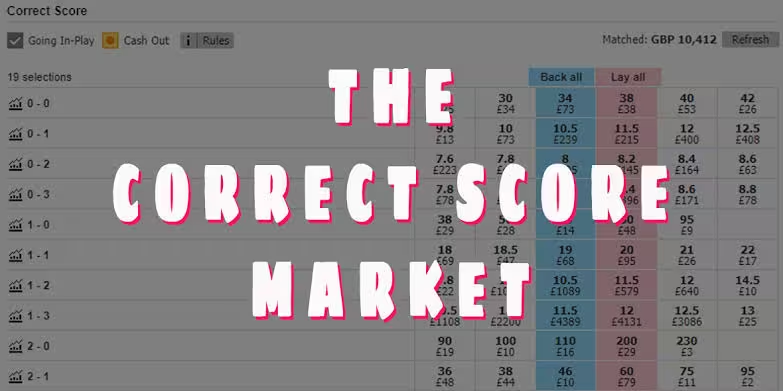
Bookmakers set correct score odds by combining advanced statistical models, extensive historical data, and real-time team information with the insights of experienced human traders. This intricate process allows them to estimate the likelihood of every possible final score in a match, converting these probabilities into betting odds.
Understanding how these odds are created is not just interesting; it can significantly improve your betting strategy by revealing the factors that influence prices. In this article, you will learn about the key elements bookmakers consider, from statistical analysis to profit margins, giving you a clearer picture of this popular and challenging betting market.
What Are Correct Score Odds?
Correct score odds are prices offered by bookmakers for you to predict the exact final score of a sporting event, most commonly in football. Unlike simply betting on which team will win, lose, or draw, this market requires you to specify the precise number of goals each team will score.
For example, you might bet on a football match ending 2-1 to the home team, or 0-0. Because predicting the exact score is much harder than predicting just the outcome, the odds for correct scores are generally much higher, offering the potential for larger payouts.
The Foundation: Statistical Models and Data
The primary method bookmakers use to set correct score odds involves sophisticated statistical models, often built around historical data. They analyze thousands of past matches to understand patterns and probabilities.
These models frequently employ a mathematical concept called the Poisson distribution, which helps predict the number of events (like goals) occurring within a fixed interval. This allows bookmakers to estimate the probability of each team scoring a certain number of goals independently, and then combine these to get probabilities for specific final scores.
Here are some of the key data points fed into these models:
- Historical Match Results: Data from previous games between the two teams, and against similar opponents.
- Team Performance Metrics: Average goals scored and conceded, shots on target, possession, and defensive solidity.
- Player Statistics: Form of key strikers, defenders, and goalkeepers, including recent goal-scoring records or clean sheets.
- League Averages: Overall goal-scoring trends and common scorelines within the specific league or competition.
Factoring in Team Strength and Form
While historical data provides a baseline, bookmakers also heavily weigh the current strength and recent form of the teams involved. A team on a winning streak with a high-scoring attack will have different probabilities for various scores than a team struggling defensively.
These factors are constantly updated and influence the initial statistical probabilities. Bookmakers adjust their models to reflect the most up-to-date information, ensuring their odds are as accurate as possible.
Consider the following aspects:
- Recent Form: How teams have performed in their last 5-10 games, including wins, losses, draws, and goals scored/conceded.
- Head-to-Head Records: Past results between the two specific teams, which can sometimes show unique patterns.
- Home Advantage: The significant impact playing at home can have on a team's performance and goal-scoring potential.
- Injuries and Suspensions: The absence of key players, especially goal scorers or defensive stalwarts, can drastically alter a team's expected performance.
- Motivation: Whether a team needs a win for promotion, relegation, or a cup final can affect their approach and effort.
The Role of Human Experts
Even with advanced algorithms, human expertise remains vital in setting correct score odds. Experienced sports traders and odds compilers review the probabilities generated by the models and make manual adjustments.
They bring a qualitative understanding that algorithms might miss, such as team morale, tactical changes, or weather conditions. These experts use their knowledge to fine-tune the odds, ensuring they reflect the most realistic outcomes.
For example, a model might predict a low-scoring game, but a human trader might know that one team has just signed a prolific striker or changed to a more attacking formation, prompting an adjustment to higher-scoring outcomes. This blend of machine learning and human judgment creates robust and competitive odds.
Calculating Implied Probability
Once bookmakers have estimated the true probability of each correct score, they convert these probabilities into odds. This conversion is straightforward: the implied probability of an outcome is 1 divided by the decimal odds. However, bookmakers don't offer odds that perfectly reflect the true probability.
Instead, they build in a profit margin, also known as vigorish or juice. This margin ensures that, over time, the bookmaker makes a profit regardless of the outcome. You can learn more about how odds relate to probability by understanding implied probability in betting.
Building in the Profit Margin (Vigorish/Juice)
The profit margin is a critical component of how bookmakers operate. After calculating the true probabilities for all possible correct scores, they reduce the payout for each outcome slightly. This reduction means that if you were to bet on every possible correct score in proportion to its implied probability, you would lose a small percentage of your total stake.
This margin is how bookmakers stay in business. For example, if a true probability for a 1-0 score is 10% (odds of 10.00), the bookmaker might offer odds of 9.00, effectively building in their profit. This ensures they have a financial edge over the long term.
Adjusting Odds: Live Betting and Market Movement
Correct score odds are not static; they change constantly, both before and during a match. Before a game, odds can shift due to new information like team news, significant betting patterns from the public, or even weather forecasts.
During live betting, the odds react instantly to events on the field. A goal, a red card, or even a sustained period of pressure from one team will cause the correct score odds to be recalculated and updated in real time. This dynamic adjustment reflects the ever-changing probabilities of different outcomes as the game unfolds.
Practical Example: How a Bookmaker Might Price a Match
To illustrate how bookmakers might set correct score odds, let's consider a hypothetical football match between Team A and Team B. The bookmaker uses their models and expert analysis to estimate the probability of various scores, then applies their profit margin.
Below is a simplified example showing how probabilities are converted to odds, including the bookmaker's margin. This table demonstrates that lower probability scores have higher odds, reflecting the difficulty in predicting them.
| Correct Score | Estimated True Probability (%) | Fair Odds (1 / Probability) | Bookmaker's Offered Odds (Example) |
|---|---|---|---|
| Team A 1-0 Team B | 12.0% | 8.33 | 7.50 |
| Team A 2-0 Team B | 8.0% | 12.50 | 11.00 |
| Team A 2-1 Team B | 9.5% | 10.53 | 9.50 |
| Team A 0-0 Team B | 7.0% | 14.29 | 12.00 |
| Team B 1-0 Team A | 10.0% | 10.00 | 9.00 |
| Team B 2-0 Team A | 6.0% | 16.67 | 14.00 |
| Team B 2-1 Team A | 7.5% | 13.33 | 11.50 |
| Any Other Score | 40.0% | 2.50 | 2.20 |
As you can see, the bookmaker's offered odds are slightly lower than the fair odds, which accounts for their profit margin. This margin is present across all betting markets, whether you are looking at how bookmakers set Draw No Bet odds or other complex markets.
Why Correct Score Betting is Challenging
Correct score betting is one of the most difficult markets to win consistently due to the sheer number of possible outcomes. Even a slight change in a match, like an early goal or a red card, can completely alter the expected final score, making your prediction invalid.
It requires a deep understanding of team dynamics, current form, and a bit of luck. While the high odds are attractive, it is important to approach this market with caution and always practice responsible betting, never wagering more than you can afford to lose.
To improve your chances, consider using statistics to improve your bets, similar to how you might use statistics to improve Draw No Bet bets. Analyzing trends in common scorelines for specific teams or leagues can provide valuable insights.
Conclusion
Bookmakers meticulously set correct score odds using a blend of statistical models, extensive data analysis, and the nuanced judgment of human experts, all while incorporating a profit margin. This complex process ensures that the odds offered reflect the estimated probabilities of various outcomes as accurately as possible. Understanding these underlying mechanisms can help you make more informed betting decisions in this exciting yet challenging market.
? Frequently Asked Questions
What is the Poisson distribution in correct score betting? ⌄
How do bookmakers make a profit from correct score odds? ⌄
Why do correct score odds change frequently? ⌄
Are correct score bets harder to win than other bets? ⌄
What data do bookmakers use to set correct score odds? ⌄
Related Articles
📬 Free Daily Predictions
Get expert picks delivered to your inbox every morning.