Understanding Draw No Bet Implied Probability

Want expert predictions delivered daily?
Get free tips on Telegram or upgrade to Premium.
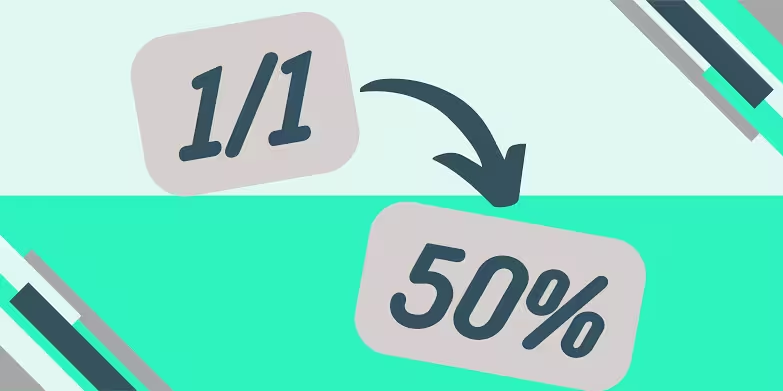
Understanding Draw No Bet (DNB) implied probability helps you assess the true likelihood of an outcome according to the bookmaker's odds, allowing you to make more informed betting decisions. This market removes the draw outcome, returning your stake if the match ends in a tie, making it a popular choice for many sports bettors.
This article will explain exactly what Draw No Bet means, how implied probability is calculated, and why combining these two concepts is essential for finding value in your sports wagers. You will learn to convert DNB odds into percentages and use this knowledge to evaluate potential bets more effectively, enhancing your overall betting strategy.
What is Draw No Bet (DNB)?
Draw No Bet (DNB) is a popular betting market where you wager on either a home win or an away win, but if the match ends in a draw, your entire stake is returned to you. This means that the draw outcome is essentially removed from the possible results, providing a safety net compared to a standard 1X2 (Win/Draw/Win) bet.
This market is particularly favored in sports like football (soccer) where draws are common, as it reduces the risk of losing your stake if the teams cannot be separated. It allows bettors to back a team to win with the assurance that a tie won't result in a complete loss, only a void bet.
How Does Draw No Bet Work in Practice?
When you place a Draw No Bet wager, you are essentially betting on one team to win, and if the game finishes level, your bet is cancelled and your money is given back. This differs significantly from a traditional 1X2 bet where a draw would mean you lose your stake if you backed either team to win.
For example, if you bet on Team A to win with a DNB market, and the match ends 1-0 to Team A, your bet wins. If the match ends 0-0, your stake is returned. However, if Team B wins 0-1, your bet loses. This market offers a balance between the higher risk of a straight win bet and the lower odds of a double chance bet.
What is Implied Probability?
Implied probability is a way to convert betting odds into a percentage, representing the bookmaker's assessment of how likely an event is to happen. It helps you understand the perceived chance of an outcome based on the odds offered, allowing you to compare your own assessment with that of the bookmaker.
Calculating implied probability is straightforward: you simply divide 1 by the decimal odds. For instance, odds of 2.00 imply a 50% chance (1 / 2.00 = 0.50), while odds of 4.00 imply a 25% chance (1 / 4.00 = 0.25). This calculation is a fundamental tool for any serious bettor looking to find value.
Calculating Draw No Bet Implied Probability
Calculating implied probability for Draw No Bet odds follows the same simple formula as any other market: 1 divided by the decimal odds. However, it's important to remember that DNB odds are generally lower than outright win odds because the risk of a draw is removed.
Let's look at a practical example to understand how this works. Suppose you are looking at a football match between Team A and Team B, and the bookmaker offers the following Draw No Bet odds:
| Outcome | DNB Odds | Implied Probability (1 / Odds) |
|---|---|---|
| Team A Win (DNB) | 1.60 | 62.50% |
| Team B Win (DNB) | 2.50 | 40.00% |
In this example, the bookmaker suggests that Team A has a 62.50% chance of winning, while Team B has a 40.00% chance. Notice that if you add these probabilities (62.50% + 40.00% = 102.50%), the total is over 100%, which is the bookmaker's 'overround' or 'vig'. This extra percentage is how bookmakers ensure a profit margin.
Why Understanding DNB Implied Probability is Important
Understanding Draw No Bet implied probability is a powerful skill for any bettor because it helps you identify potential value bets. By converting odds into percentages, you can compare the bookmaker's assessment of an event's likelihood with your own analysis.
If you believe Team A has a 70% chance of winning, but the DNB odds imply only a 62.50% chance, you've found a potential value bet. This means you think the bookmaker has underestimated Team A's chances, and betting on them could be profitable in the long run. This analytical approach is key to smart betting, much like managing your bankroll with the 1% bankroll rule.
Comparing DNB with 1X2 Implied Probability
To truly appreciate the value of DNB, it's useful to compare its implied probabilities with those of the standard 1X2 market. The DNB market essentially redistributes the probability of the draw outcome to the two win outcomes, resulting in lower odds but also lower risk.
Here is a comparison of typical odds and their implied probabilities for a match, showing how the DNB market adjusts the perceived chances:
| Outcome | 1X2 Odds | 1X2 Implied Probability | DNB Odds | DNB Implied Probability |
|---|---|---|---|---|
| Team A Win | 2.20 | 45.45% | 1.50 | 66.67% |
| Draw | 3.40 | 29.41% | N/A | N/A |
| Team B Win | 3.20 | 31.25% | 2.30 | 43.48% |
As you can see, the DNB odds for a win are lower than the 1X2 odds, but their implied probabilities are higher. This reflects the reduced risk, as the draw outcome is removed. Understanding this difference helps you choose the right market for your betting strategy, whether you're exploring player assists betting or traditional outcomes.
Responsible Betting with DNB
While Draw No Bet offers a safety net, it's still important to practice responsible betting. The lower odds in DNB markets mean that you'll need to win more often to make a profit compared to higher-risk bets.
Always set a budget for your betting activities and stick to it, never chasing losses. Understanding implied probability helps you make calculated decisions rather than emotional ones, which is a cornerstone of responsible gambling. Remember, betting should always be for entertainment, and you should only wager what you can afford to lose.
You can learn more about managing your betting finances by exploring resources like how to bet on 1xBet responsibly or understanding how to use free bets on a newly registered account.
Conclusion
Understanding Draw No Bet implied probability is a valuable skill that empowers you to make more informed and strategic betting decisions. By converting DNB odds into percentages, you gain insight into the bookmaker's assessment and can identify situations where your own analysis suggests greater value. This approach helps reduce risk while still offering opportunities for profit, making DNB a favored market for many sports bettors.
? Frequently Asked Questions
What is the main benefit of Draw No Bet? ⌄
How do Draw No Bet odds compare to 1X2 odds? ⌄
Can I use Draw No Bet in all sports? ⌄
What happens to my bet if the game is a draw in DNB? ⌄
Is Draw No Bet a safer option? ⌄
How do I calculate implied probability for any bet? ⌄
Related Articles
- How to view settled multi-bets on the 22Bet Kenya application
- How to turn off promotional SMS alerts from SportPesa
- how to cash out an active ticket on sportybet kenya
- How to change your registered phone number on Betika
- How to edit a bet slip after placing it on SportyBet
- How to check your Betika bet history offline via USSD
- How to Use 1xBet Bonus Wallet in Kenya
📬 Free Daily Predictions
Get expert picks delivered to your inbox every morning.